AHV & Pension Fund
What is Switzerland's three-pillar retirement system?
Swiss retirement provision rests on three pillars: the state pension (AHV), the occupational pension fund (BVG), and the voluntary Pillar 3a. How much these three pillars add up to at retirement depends heavily on your income, your contribution years, and your municipality. SwissPillar4 combines all three pillars using your own figures and shows you an overall estimate.
How much AHV state pension will I receive?
Your AHV pension depends on your average lifetime income and your contribution years — with a full contribution record it falls between the minimum and maximum pension. Missing contribution years reduce the pension disproportionately. SwissPillar4 calculates your projected AHV pension automatically from your inputs.
What if I have gaps in my AHV contributions?
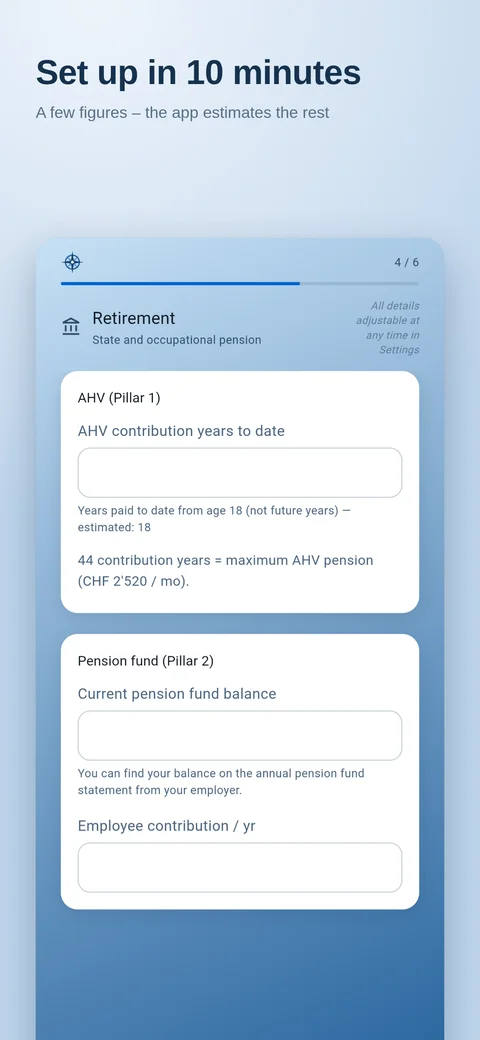
Missing AHV contribution years reduce your pension disproportionately and can be closed retroactively for up to 5 years through a top-up payment. SwissPillar4 compares your entered contribution years against the 44 years needed for a full pension and shows you how much extra AHV pension a top-up for the missing years would bring.
How much AHV will I get if I've lived or worked abroad?
Years spent abroad without Swiss AHV contributions count as contribution gaps just like any other missing year, reducing your pension the same way. SwissPillar4 doesn't distinguish the reason behind a gap — it simply compares your entered contribution years against the 44 years needed for a full pension and shows you the effect of closing the difference with a retroactive top-up.
How much AHV do married couples receive combined?
A married couple's combined AHV pension is capped by law (Art. 35 AHVG) — even if both partners would individually qualify for the full pension, the combined amount above this ceiling is reduced. SwissPillar4 accounts for this couple's cap as soon as you enter details for a partner, and factors the reduced combined pension into your overall picture.
From what age can I retire early in Switzerland?
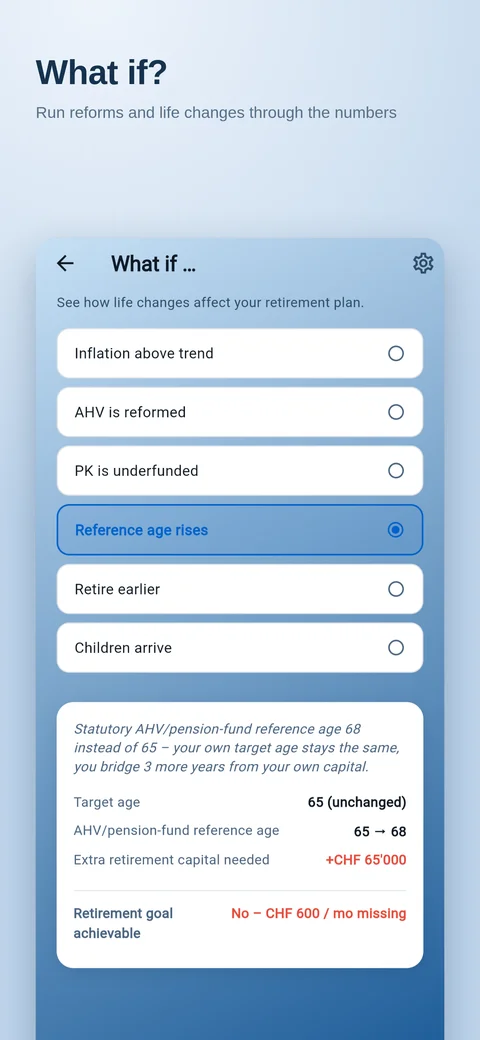
AHV and pension fund income normally only start at 65. If you want to stop working sooner, you have to fund the years in between entirely from your own capital — and that typically takes noticeably more wealth than people first assume, because that capital has to replace your entire income. SwissPillar4 estimates what exit age is realistic given your current savings behavior and whether your goal is achievable. Early withdrawal of AHV (from 63, with a lifelong reduction of roughly 6.8% per year) or of pension fund capital is deliberately not factored in — the app consistently sticks to the ordinary age of 65. What it does factor in is your own savings, including your Pillar 3a balance, which becomes available from age 60, to bridge the time until then.
Tax Optimization
Is Pillar 3a worth it?
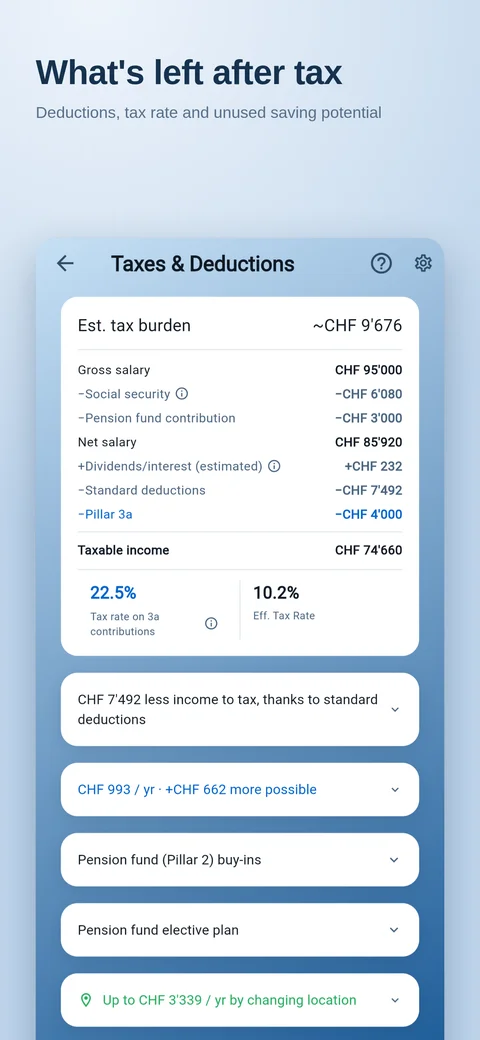
Pillar 3a contributions are deductible from your taxable income — how much that actually saves depends on your income, your marginal tax rate, and your municipality. SwissPillar4 shows you the tax saving in CHF for your specific situation, rather than a generic rule of thumb.
How much can I contribute to Pillar 3a in 2026?
The maximum Pillar 3a contribution is set by law: in 2026 it's CHF 7,258 per year for employees with a pension fund, and up to CHF 36,288 (20% of earned income) for self-employed people without one. SwissPillar4 automatically calculates how much room you still have up to this maximum and what an additional contribution would save in tax.
How much tax does a pension fund buy-in save?
A voluntary buy-in into your pension fund is also deductible from taxable income, often to a greater extent than a Pillar 3a contribution. Important: if the capital is withdrawn within three years of a buy-in, the tax authority retroactively denies the deduction (a blocking period under Art. 79b para. 3 BVG). SwissPillar4 calculates the tax effect of a buy-in for your situation in CHF.
What's better: a pension fund buy-in or topping up Pillar 3a?
Both options are deductible from your taxable income, but they're capped differently: a pension fund buy-in is limited by your individual purchase gap from your pension fund certificate, while Pillar 3a is limited by the fixed annual legal maximum. There's also how the money is invested — your pension fund pays a fixed rate set by the fund, while with Pillar 3a you control your own investment strategy and therefore the expected return. SwissPillar4 calculates the tax saving for both options using the same underlying logic in CHF, so you can compare them directly.
How can I reduce the tax on my capital withdrawal?
Withdrawing your pension fund or Pillar 3a capital in stages instead of all at once — for example via several 3a accounts or withdrawals in different years — noticeably reduces the tax progression on the payout. SwissPillar4 shows you the savings potential of staggering in CHF for your situation.
Deciding on Retirement
Pension fund: lump sum or annuity?
Both options affect your income, taxes, and security in retirement differently — which one fits depends on your personal situation. SwissPillar4 compares the effects of a full pension and a lump-sum withdrawal using your own figures, without pushing you toward a decision.
Will my retirement savings be enough?
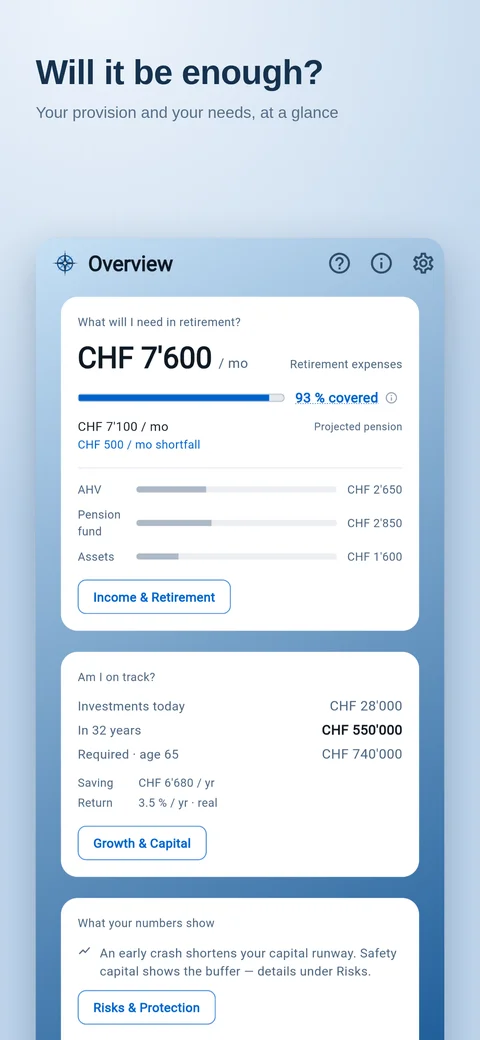
Generic rules of thumb like “CHF 500,000 is enough” or fixed savings targets by age fall short, because they ignore both your actual expenses and your AHV and pension fund income. Whether your retirement savings are enough can only be answered with your own figures. SwissPillar4 compares your projected retirement income — AHV, pension fund, and Pillar 3a combined — against your projected expenses at retirement, both already adjusted for inflation for an easy comparison to today's figures, and shows you whether a gap exists.
Investing & Budgeting
How should I invest my money for retirement?
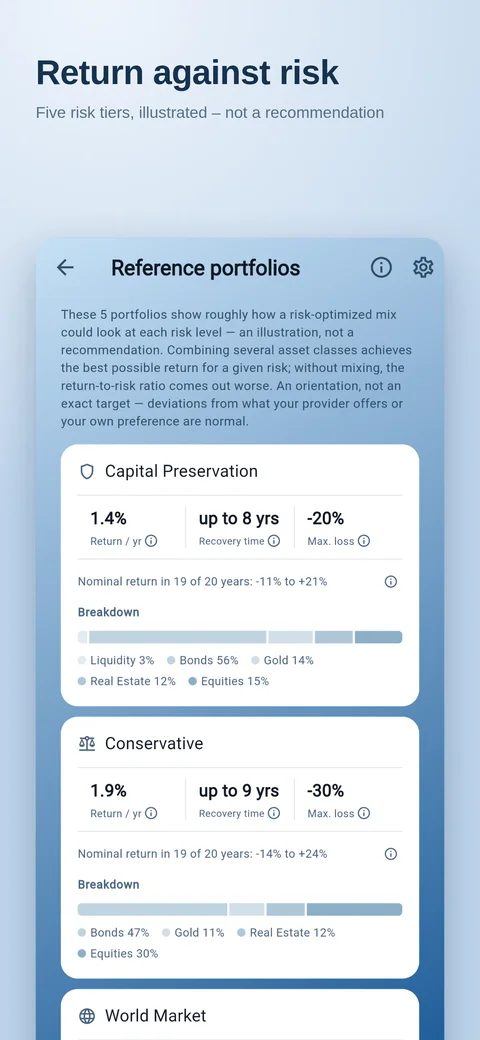
What matters most is how much risk you take on and how sensibly you spread it to achieve a good return — you don't need to be an investment expert for that. Simple, broadly diversified investment products and an automatic savings plan already get you a solid setup. SwissPillar4 shows you expected return, recovery time after a crash, and maximum drawdown as reference points across different risk levels, from defensive to dynamic, and places your own equity ratio across Pillar 3a and brokerage accounts within that picture — without giving investment advice under FIDLEG. If you want to try this out risk-free, the app's game mode lets you experience 40 years of investment strategy in half an hour, without risking real money.
How much do fund fees eat into my returns?
Fund and brokerage fees act like a silent return-killer over decades — even 0.5 percentage points less in annual cost makes a noticeable difference to your retirement capital over a long horizon. Combined savings-and-insurance products (Pillar 3a or 3b as an insurance policy) are a common example of this: costs stay opaque, and separate risk and savings products are usually cheaper. SwissPillar4 calculates the cost effect on your own invested capital in CHF.
What should I do when the stock market crashes?
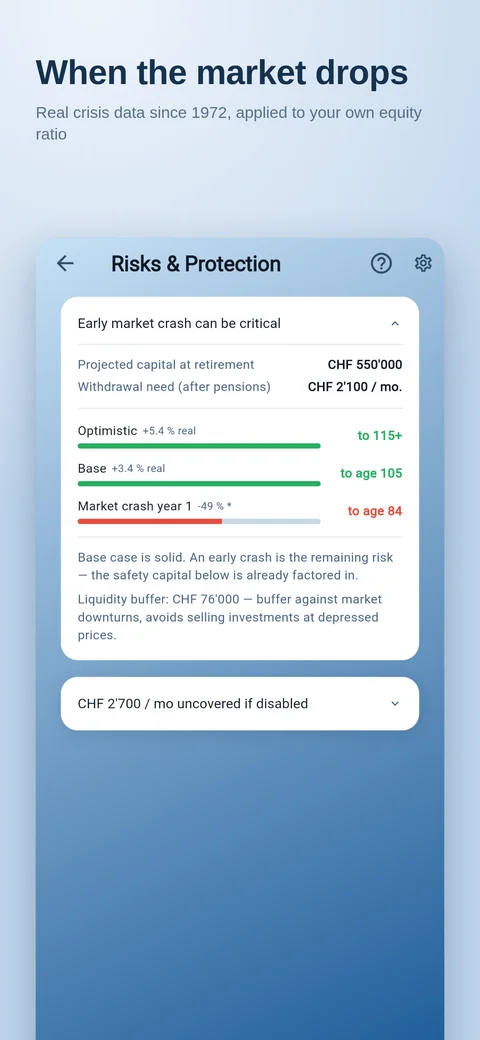
Historically, markets have recovered after every crash — the real question is how long that takes, and whether the timing is bad for you. A crash shortly before or during retirement is especially risky if you're already withdrawing capital (sequence-of-returns risk). SwissPillar4 has a dedicated calculation for exactly this scenario: it simulates, using real historical crisis data going back to 1972 matched to your actual equity ratio, whether your capital would still last through retirement even if a crash hits at the worst possible time.
How do I keep track of my budget?
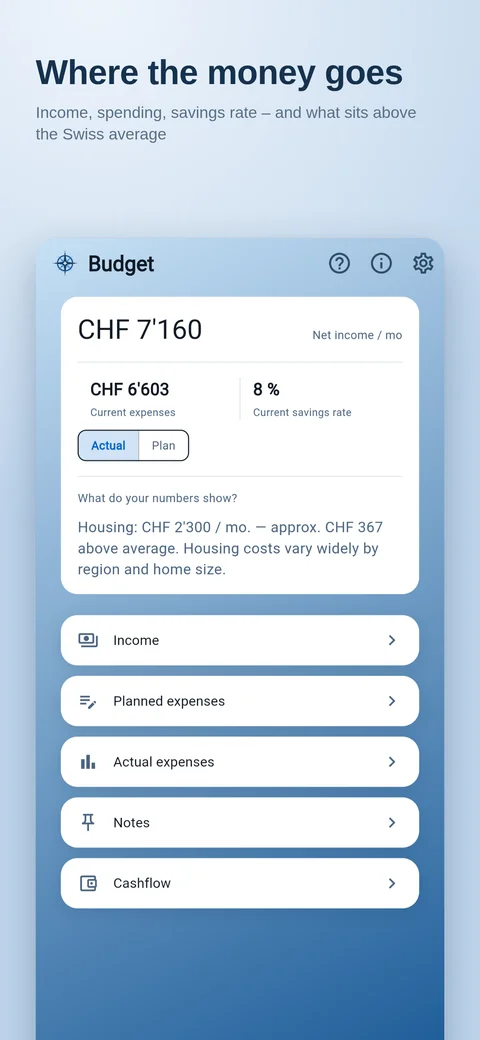
It's less about meticulous bookkeeping than about knowing where your money actually goes, staying in control, and knowing and planning your real savings rate. You enter your income and expenses yourself — SwissPillar4 doesn't capture them automatically, but helps you categorize, analyze, and securely store them. From that, the app calculates your savings rate and additionally shows you which categories are noticeably above the Swiss average (based on the Federal Statistical Office's household budget survey).
What does investing have to do with my retirement savings?
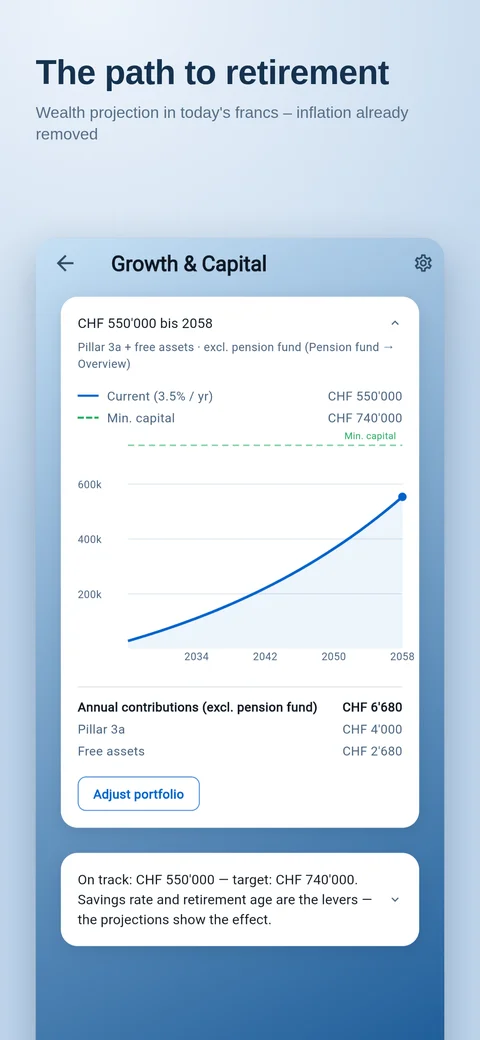
How you invest your retirement capital — in Pillar 3a or a free brokerage account — directly determines how much capital you'll have at retirement and how much of it you can withdraw each year for spending. A higher expected return means more capital, but also more fluctuation. SwissPillar4 calculates with your actual investment return instead of a flat withdrawal rate, showing you the direct link between your investment strategy and your retirement income.
Buying a Home
Can I afford to buy a home in Switzerland?
Whether you can afford a home depends on two factors that influence each other: your equity and your income. By law you need at least 20% equity, of which at least 10% may not come from your pension fund — equity counts savings, your brokerage account, your Pillar 3a balance, and a possible pension fund early withdrawal (WEF) for the rest. On top of that, affordability has to work out: an imputed mortgage rate plus maintenance costs must not exceed 33% of your income. More equity lowers the mortgage you need and can ease this affordability hurdle — conversely, a high income can't substitute for the legal 20% equity minimum. SwissPillar4 calculates your maximum affordable purchase price and your equity breakdown using your own figures.
Is buying a home in Switzerland worth it, or is renting better?
This depends not just on the purchase price, but on what your equity would earn instead if you invested it and kept renting. SwissPillar4 compares this opportunity cost — the return on your equity if you buy versus the investment return if you rent — using your own figures; a mortgage amortization schedule is not part of the analysis.
↑ Run your own numbers in the app
For official information on the retirement process (application, deadlines), see the Federal Social Insurance Office (FSIO).